|
Did really everybody understand each other before
the “confusion” happened at Babel? Or was that “misunderstanding”
caused by a mass of foreign “guest-worker” – speaking different
languages - coming over to build the huge tower of Babel? This was
also the time, when the Acadians – speaking a dialect of the
agglutinating Sumerian language – started hiding their power-giving
knowledge by introducing kabala and “temura” into the writing system
to make it inaccessible for aggressive new immigrants.

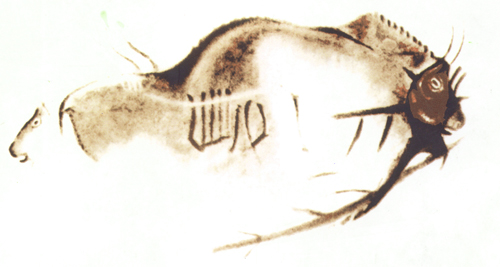
A nicely fashioned
script can be seen on this 20.000 year-old painting
(Pech Merle - France)
It is a widespread belief that there was a common language spoken by
our early ancestors and linguists call it the “proto-nostratic” or „nostratic
language".
Some linguists try to figure out what this common language looked
like and which languages are the closest successors of it. Other
linguists however, deny its possible existence or refuse to deal
with.
We are convinced that early humans - our common ancestors - were
intelligent and lived in well-organized
neighborhoods.
Intelligent people communicate with each other, write down important
notes as well as numbers.
Varga Csaba demonstrates in his book “Signs
- Letters - Alphabets”
the over 30,000 years writing history of humans.
Our ancestors left beautiful murals and
drawings
behind on cave-walls in South-France and Portugal 30 thousands years
ago. They wrote signs and
numbers
on these pictures. Some signs turned out as letters of our archaic
alphabets - the forerunners of the Latin alphabet.
The numerals written on these pictures -
dots and lines - were used in
old Egypt, by the Mayas until 1500AD and by Hungarian-Szekely people
in the salt-mines of Transylvania until 100 years ago.
This lines and dots became the wires and balls of the “abacus”,
therefore millions of people are still using those archaic way of
calculation all over the world.
Letters of an alphabet can be used by different languages but “ligatures”
- the combination of several letters - are made for and can be read
in one special language only.
The same signs, the same letters returned again and again during the
30.000 years of history across Eurasia. People of different cultures
at different times picked always “letters” out of the same “sign-collection”
(the letter collection) to build an alphabet fitting properly their
language.
This means for us that high quality human culture must
have existed before 35.000 Years even when most of the artifacts,
which could proof this, disappeared due to decay or to natural and
man-made disasters. In spite of temporary recessions because of huge
catastrophic events
around 12.500 and 5-6.000 years ago, human culture must have been
continuous until now.

Signs-
Letters - Alphabets
Anima Könyv:
Signs-Letter-Alphabets
|